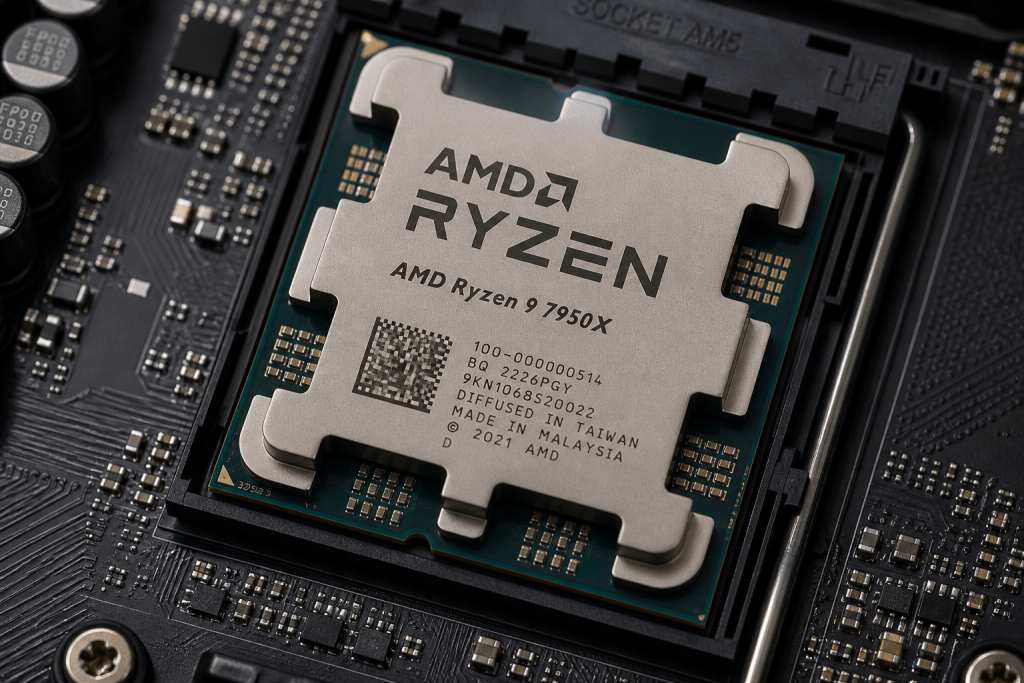
Shares of Advanced Micro Devices fell about 5% on Monday after HSBC downgraded the chipmaker, warning that much of the recent rally may already be priced in ahead of its first-quarter earnings report.
The downgrade comes after a sharp surge in AMD’s stock, which has climbed more than 68% this year and roughly 258% over the past 12 months.
April alone marked the company’s strongest month on record, with shares soaring more than 74% and hitting an all-time high of $362.79.
HSBC analyst Frank Lee cut the rating to Hold from Buy, citing stretched valuations and limited near-term upside in the company’s central processing unit, or CPU, business.
While the firm raised its price target slightly to $340, that still implies a modest downside from current levels.
Rising expectations weigh on outlook
Lee said the stock’s rapid ascent has significantly lifted investor expectations, particularly around AMD’s server CPU growth.
“We had been bullish on AMD, driven by its consistent share gains in the server CPU market,” he wrote, adding that the recent rally “has significantly raised market expectations over its server CPU growth momentum.”
The valuation has also expanded sharply.
AMD is now trading at about 33 times estimated 2027 earnings, up from around 19 times previously, according to HSBC.
That shift reflects growing optimism around artificial intelligence but leaves less room for upside surprises.
At the same time, technical indicators suggest the stock may be overheated.
AMD’s 14-day relative strength index has climbed above 84, placing it firmly in overbought territory, though analysts note that strong earnings could still extend the rally.
AI demand strong but supply remains a constraint
Demand for chips tied to artificial intelligence continues to underpin AMD’s growth story.
Alongside rival Intel, the company has benefited from rising demand for CPUs that power increasingly complex AI workloads.
However, HSBC flagged supply limitations as a key risk.
AMD relies heavily on Taiwan Semiconductor Manufacturing Company for production, and capacity constraints at the foundry are expected to persist through the end of the year.
While a tight supply may support pricing, it also limits the company’s ability to fully capitalise on strong demand.
HSBC said these constraints could cap volume growth in both CPU and AI graphics processing unit, or GPU, segments.
The bank has trimmed its full-year estimates for both categories, even as it expects first-quarter results to meet consensus forecasts.
Looking ahead, HSBC noted that supply constraints are likely to ease over time as Taiwan Semiconductor expands capacity across facilities in Taiwan, Japan, and the United States.
However, the firm said it would need clearer visibility on production before turning more constructive on the stock.
Earnings in focus amid mixed signals
AMD is scheduled to report results on May 5 for the quarter ended March 31.
Analysts expect revenue to rise about 33% to $9.89 billion, up from $7.44 billion a year earlier, according to LSEG data.
Earnings are projected at $1.29 per share.
The company had previously guided for revenue between $9.50 billion and $10.10 billion, suggesting results could land within expectations.
The competitive landscape also remains a factor.
HSBC sees potential for Intel to deliver upside surprises in the coming quarters, supported by its in-house manufacturing capabilities, which could help it regain some market share compared to AMD.
The post AMD stock slips as HSBC downgrade flags valuation concerns ahead of earnings appeared first on Invezz




More Stories
Why are UPS, FedEx stocks falling today?
Circle stock surges as CLARITY Act deal reshapes crypto yield
Nebius shares jump 12% as $643M Eigen AI deal boosts inference ambitions