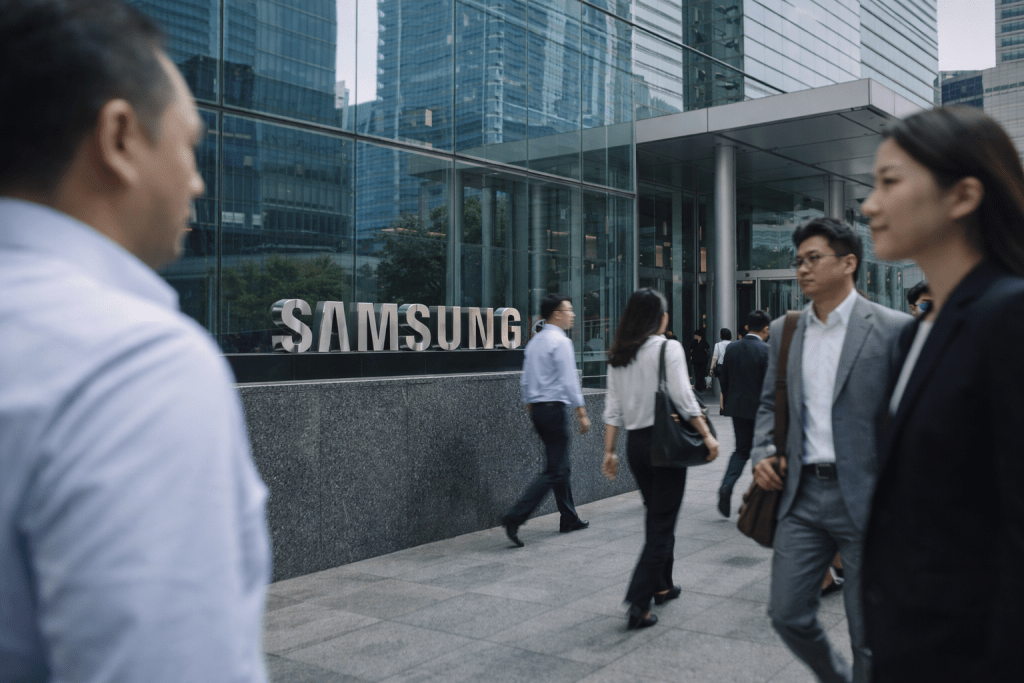
Samsung Electronics on Thursday reported the strongest quarterly results in its history, as a near-50-fold surge in chip earnings driven by artificial intelligence data centre spending lifted operating profit to a fresh record.
The strong figures prompted the South Korean technology giant to signal continued momentum for the rest of the year.
Samsung said operating profit for the January–March quarter reached 57.2 trillion won, matching its own earlier guidance and compared with 6.69 trillion won a year earlier.
Revenue rose approximately 70% year on year to 133.9 trillion won, also a quarterly record.
The chip division delivered 53.7 trillion won in operating profit, up from just 1.1 trillion won in the same period last year, accounting for 94% of the total.
The results surpassed Samsung’s full-year 2025 operating profit of 43.6 trillion won in a single quarter.
AI infrastructure keeps memory tight
Samsung said the record reflected strong momentum in AI-driven spending and expected the trend to continue as data centre construction keeps memory supply constrained.
The company said it had signed multi-year binding contracts with customers to secure server memory supply for data centre construction, though it declined to disclose further identities or terms.
It said it expected server memory demand to remain strong as hyperscalers including Alphabet, Meta and Amazon accommodate enterprises’ increasing adoption of AI for large language models, and as agentic AI — systems capable of operating autonomously — accelerates demand growth in the second half of this year.
Samsung’s memory business “surpassed its quarterly sales record by addressing high-value-added AI demand despite limited supply availability, with industry-wide memory price increases also a contributing factor,” the company said.
The day before Samsung’s earnings, major US technology groups including Alphabet, Amazon and Microsoft signalled sustained AI infrastructure spending, reinforcing the industry-wide demand picture.
HBM4 sales begin for Nvidia’s Vera Rubin platform
Samsung said it had commenced the industry’s first mass-production sales of HBM4 chips for Nvidia’s Vera Rubin AI accelerator platform, targeting the data centre and high-performance computing markets.
The milestone marks a significant step in its effort to narrow the competitive gap with SK Hynix in the high-bandwidth memory segment, where it had previously fallen behind.
SK Hynix last week reported a quarterly profit record, with a fivefold jump in earnings, and forecast a prolonged industry upcycle.
Samsung also said it would maintain its target of generating more than half of semiconductor revenue from non-memory products, and that its foundry business remained on track to return to profitability in the second half of the year.
Phones and displays face margin pressure
Not all divisions shared in the chip windfall.
Samsung’s mobile and network division saw profit fall 35% in the first quarter to 2.8 trillion won, weighed down by rising component costs.
Its display division, which supplies screens to customers including Apple, posted operating profit of 400 billion won, a 20% decline.
Samsung said it expected smartphone margins to remain under pressure from higher manufacturing costs and flagged lower margins from its display business.
It said smartphone sales were likely to fall in the current quarter as the boost from flagship launches fades, though it would maintain its mid-to-high single-digit market share in China this year.
“While demand for semiconductors is set to increase due to the growth of the AI industry, a conflicting business environment is anticipated as the cost of IT products rises,” Samsung said.
The company added it would continue to monitor the conflict in the Middle East, which poses risks to its raw material and energy supply chains given South Korea’s significant dependence on imported energy.
Samsung stock slip after early gains
Samsung shares slipped 1.3% after rising as much as 1.8% following the earnings announcement.
The stock has surged 88% this year, well ahead of the benchmark index’s 59% gain.
Thursday’s drop came as market had already priced in perfection, and anything short of a major upside surprise triggers profit-taking.
Investors are now shifting focus from backward-looking record earnings to forward risks: peak chip margins, reliance on AI demand, and macro uncertainty.
With expectations stretched, even strong guidance may struggle to push the stock higher in the near term.
The post Why Samsung stock is falling after its best quarter in history? appeared first on Invezz



More Stories
FTSE 100, DAX, CAC 40 futures fall as risk rises ahead of ECB, BoE
Nikkei 225 slides as Asian markets split on oil surge, Fed pause
Alphabet stock surges 5% as sales beat estimates